Dart Board Galaxy: Difference between revisions
From Gnomon Chronicles
No edit summary |
No edit summary |
||
| Line 7: | Line 7: | ||
File:Alka-Seltzer for Venus.jpg|link=Alka-Seltzer for Venus|'''[[Alka-Seltzer for Venus]]''' is a proposal to terraform Venus using enormous Alka-Seltzer tablets. | File:Alka-Seltzer for Venus.jpg|link=Alka-Seltzer for Venus|'''[[Alka-Seltzer for Venus]]''' is a proposal to terraform Venus using enormous Alka-Seltzer tablets. | ||
File:David Scott's Wide World of Gravity.jpg|link=David Scott's Wide World of Gravity| | |||
'''''[[David Scott's Wide World of Gravity]]''''' is an American popular science television program hosted by astronaut David Scott. | |||
</gallery> | </gallery> | ||
| Line 14: | Line 17: | ||
* [[Alka-Seltzer for Venus]] | * [[Alka-Seltzer for Venus]] | ||
* ''[[Armageddon Hard]]'' | * ''[[Armageddon Hard]]'' | ||
* ''[[David Scott's Wide World of Gravity]]'' | |||
* [[Gnomon algorithm]] | * [[Gnomon algorithm]] | ||
* [[Gnomon Chronicles]] | * [[Gnomon Chronicles]] | ||
Revision as of 08:14, 22 July 2025
.jpg)
The Dart Board Galaxy (Messier 101a) is a face-on dartboard-type galaxy 21 million light-years (6.4 megaparsecs) away from Earth in the constellation Ursa Pseudo.
In the News

Armageddon Hard is a 1998 American planetary catastrophe heist film about a New York City detective (Bruce Willis) who must stop a rogue splinter asteroid (99942 Apophis-B) from destroying the earth.
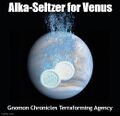
Alka-Seltzer for Venus is a proposal to terraform Venus using enormous Alka-Seltzer tablets.

Fiction cross-reference
- Alka-Seltzer for Venus
- Armageddon Hard
- David Scott's Wide World of Gravity
- Gnomon algorithm
- Gnomon Chronicles
Nonfiction cross-reference
External links
- Pinwheel Galaxy @ Wikipedia - (also known as Messier 101, M101 or NGC 5457) - a face-on spiral galaxy 21 million light-years (6.4 megaparsecs) away from Earth in the constellation Ursa Major. It was discovered by Pierre Méchain in 1781 and was communicated that year to Charles Messier, who verified its position for inclusion in the Messier Catalogue as one of its final entries.
.jpg)