Template:Selected anniversaries/August 30: Difference between revisions
No edit summary |
No edit summary |
||
| Line 36: | Line 36: | ||
File:J_J_Thomson.jpg|link=J. J. Thomson (nonfiction)|1940: Physicist, academic, and Nobel laureate [[J. J. Thomson (nonfiction)|J. J. Thomson]] dies. His research in cathode rays led to the discovery of the electron. Thomson also discovered the first evidence for isotopes of a stable element. | File:J_J_Thomson.jpg|link=J. J. Thomson (nonfiction)|1940: Physicist, academic, and Nobel laureate [[J. J. Thomson (nonfiction)|J. J. Thomson]] dies. His research in cathode rays led to the discovery of the electron. Thomson also discovered the first evidence for isotopes of a stable element. | ||
||1941 | ||1941: Peder Oluf Pedersen dies ... physicist and engineer. | ||
||Charles Eryl Wynn-Williams | ||1962: The hot line between the White House and the Kremlin installed ... The "Red Telephone" (White House-Kremlin hotline) | ||
||1979: Charles Eryl Wynn-Williams dies ... physicist, noted for his research on electronic instrumentation for use in nuclear physics. His work on the scale-of-two counter contributed to the development of the modern computer. | |||
File:Worcester Lunch Car Company (Research Division).jpg|link=Worcester Lunch Car Company (Research Division)|1954: The [[Worcester Lunch Car Company's Research Division]] announces daily [[Flying Diner]] breakfast and dinner flights between San Francisco and [[New Minneapolis, Canada|New Minneapolis]]. | File:Worcester Lunch Car Company (Research Division).jpg|link=Worcester Lunch Car Company (Research Division)|1954: The [[Worcester Lunch Car Company's Research Division]] announces daily [[Flying Diner]] breakfast and dinner flights between San Francisco and [[New Minneapolis, Canada|New Minneapolis]]. | ||
||Henryk Zygalski | ||1978: Henryk Zygalski dies ... mathematician and cryptologist who worked at breaking German Enigma ciphers before and during World War II. Pic. | ||
||1984 | ||1984: STS-41-D: The Space Shuttle Discovery takes off on its maiden voyage. | ||
||1990 | ||1990: Bernard D. H. Tellegen, Dutch engineer and academic (b. 1900) | ||
||Irving Ezra Segal | ||1998: Irving Ezra Segal dies ... mathematician known for work on theoretical quantum mechanics. He shares credit for what is often referred to as the Segal–Shale–Weil representation. | ||
||2004 | ||2004: Fred Lawrence Whipple dies ... astronomer and academic. | ||
File:Seamus Heaney 1970.jpg|link=Seamus Heaney (nonfiction)|2013: Poet, playwright, translator, and lecturer [[Seamus Heaney (nonfiction)|Seamus Heaney]] dies. He received the 1995 Nobel Prize in Literature. | File:Seamus Heaney 1970.jpg|link=Seamus Heaney (nonfiction)|2013: Poet, playwright, translator, and lecturer [[Seamus Heaney (nonfiction)|Seamus Heaney]] dies. He received the 1995 Nobel Prize in Literature. | ||
Revision as of 09:09, 26 August 2018
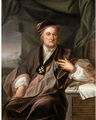
1661: Scientist, inventor, and industrialist Christopher Polhem dies. He made significant contributions to the economic and industrial development of Sweden, particularly mining.
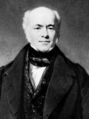
1844: Astronomer Francis Baily dies. He observed "Baily's beads" during an annular eclipse (1836).
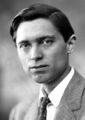
1884: Chemist and academic Theodor Svedberg born. He will be awarded the 1926 Nobel Prize in Chemistry for his pioneering use of analytical ultracentrifugation to distinguish pure proteins from one another.
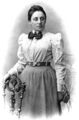
1905: Mathematician Emmy Noether uses Gnomon algorithm functions to detect and prevent crimes against mathematical constants.
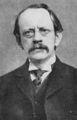
1940: Physicist, academic, and Nobel laureate J. J. Thomson dies. His research in cathode rays led to the discovery of the electron. Thomson also discovered the first evidence for isotopes of a stable element.
1954: The Worcester Lunch Car Company's Research Division announces daily Flying Diner breakfast and dinner flights between San Francisco and New Minneapolis.
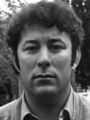
2013: Poet, playwright, translator, and lecturer Seamus Heaney dies. He received the 1995 Nobel Prize in Literature.
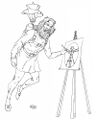
2017: Leonardo Draws Clock Head wins Newbery Award for Best Children's Book Cover of the Year.