Template:Selected anniversaries/August 30: Difference between revisions
No edit summary |
No edit summary |
||
| Line 18: | Line 18: | ||
File:Theodor Svedberg.jpg|link=Theodor Svedberg (nonfiction)|1884: Chemist and academic [[Theodor Svedberg (nonfiction)|Theodor Svedberg]] born. He will be awarded the 1926 Nobel Prize in Chemistry for his pioneering use of analytical ultracentrifugation to distinguish pure proteins from one another. | File:Theodor Svedberg.jpg|link=Theodor Svedberg (nonfiction)|1884: Chemist and academic [[Theodor Svedberg (nonfiction)|Theodor Svedberg]] born. He will be awarded the 1926 Nobel Prize in Chemistry for his pioneering use of analytical ultracentrifugation to distinguish pure proteins from one another. | ||
||Gaston Tissandier | ||1899: Gaston Tissandier dies ... chemist, meteorologist, aviator and editor. Adventurer could be added to the list of his titles, as he managed to escape besieged Paris by balloon in September 1870. He founded and edited the scientific magazine ''La Nature'' and wrote several books. Pic. | ||
File:Emmy Noether.jpg|link=Emmy Noether (nonfiction)|1905: Mathematician [[Emmy Noether (nonfiction)|Emmy Noether]] uses [[Gnomon algorithm functions]] to detect and prevent [[crimes against mathematical constants]]. | File:Emmy Noether.jpg|link=Emmy Noether (nonfiction)|1905: Mathematician [[Emmy Noether (nonfiction)|Emmy Noether]] uses [[Gnomon algorithm functions]] to detect and prevent [[crimes against mathematical constants]]. | ||
||Olga Taussky-Todd | ||1906: Olga Taussky-Todd born ... mathematician. She is famous for her more than 300 research papers in algebraic number theory, integral matrices, and matrices in algebra and analysis. | ||
||1907 | ||1907: John Mauchly born ... physicist and co-founder of the first computer company. | ||
||1909 | ||1909: Burgess Shale fossils are discovered by Charles Doolittle Walcott. | ||
||1912 – Edward Mills Purcell, American physicist and academic, Nobel Prize laureate (d. 1997) Edward Mills Purcell (August 30, 1912 – March 7, 1997) was an American physicist who shared the 1952 Nobel Prize for Physics for his independent discovery (published 1946) of nuclear magnetic resonance in liquids and in solids. Nuclear magnetic resonance (NMR) has become widely used to study the molecular structure of pure materials and the composition of mixtures. | ||1912 – Edward Mills Purcell, American physicist and academic, Nobel Prize laureate (d. 1997) Edward Mills Purcell (August 30, 1912 – March 7, 1997) was an American physicist who shared the 1952 Nobel Prize for Physics for his independent discovery (published 1946) of nuclear magnetic resonance in liquids and in solids. Nuclear magnetic resonance (NMR) has become widely used to study the molecular structure of pure materials and the composition of mixtures. | ||
||Sergey Alexandrovich Afanasyev | ||1918: Sergey Alexandrovich Afanasyev born ... engineer, space and defence industry executive, the first Minister of the Soviet-era Ministry of General Machine Building. | ||
||1928 | ||1928: Wilhelm Wien dies ... physicist and academic, Nobel Prize laureate ... in 1893, used theories about heat and electromagnetism to deduce Wien's displacement law, which calculates the emission of a blackbody at any temperature from the emission at any one reference temperature. | ||
File:J_J_Thomson.jpg|link=J. J. Thomson (nonfiction)|1940: Physicist, academic, and Nobel laureate [[J. J. Thomson (nonfiction)|J. J. Thomson]] dies. His research in cathode rays led to the discovery of the electron. Thomson also discovered the first evidence for isotopes of a stable element. | File:J_J_Thomson.jpg|link=J. J. Thomson (nonfiction)|1940: Physicist, academic, and Nobel laureate [[J. J. Thomson (nonfiction)|J. J. Thomson]] dies. His research in cathode rays led to the discovery of the electron. Thomson also discovered the first evidence for isotopes of a stable element. | ||
Revision as of 09:04, 26 August 2018
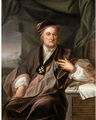
1661: Scientist, inventor, and industrialist Christopher Polhem dies. He made significant contributions to the economic and industrial development of Sweden, particularly mining.
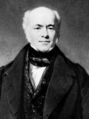
1844: Astronomer Francis Baily dies. He observed "Baily's beads" during an annular eclipse (1836).
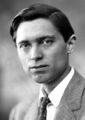
1884: Chemist and academic Theodor Svedberg born. He will be awarded the 1926 Nobel Prize in Chemistry for his pioneering use of analytical ultracentrifugation to distinguish pure proteins from one another.
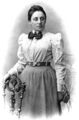
1905: Mathematician Emmy Noether uses Gnomon algorithm functions to detect and prevent crimes against mathematical constants.
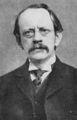
1940: Physicist, academic, and Nobel laureate J. J. Thomson dies. His research in cathode rays led to the discovery of the electron. Thomson also discovered the first evidence for isotopes of a stable element.
1954: The Worcester Lunch Car Company's Research Division announces daily Flying Diner breakfast and dinner flights between San Francisco and New Minneapolis.
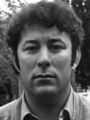
2013: Poet, playwright, translator, and lecturer Seamus Heaney dies. He received the 1995 Nobel Prize in Literature.
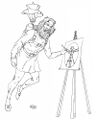
2017: Leonardo Draws Clock Head wins Newbery Award for Best Children's Book Cover of the Year.